

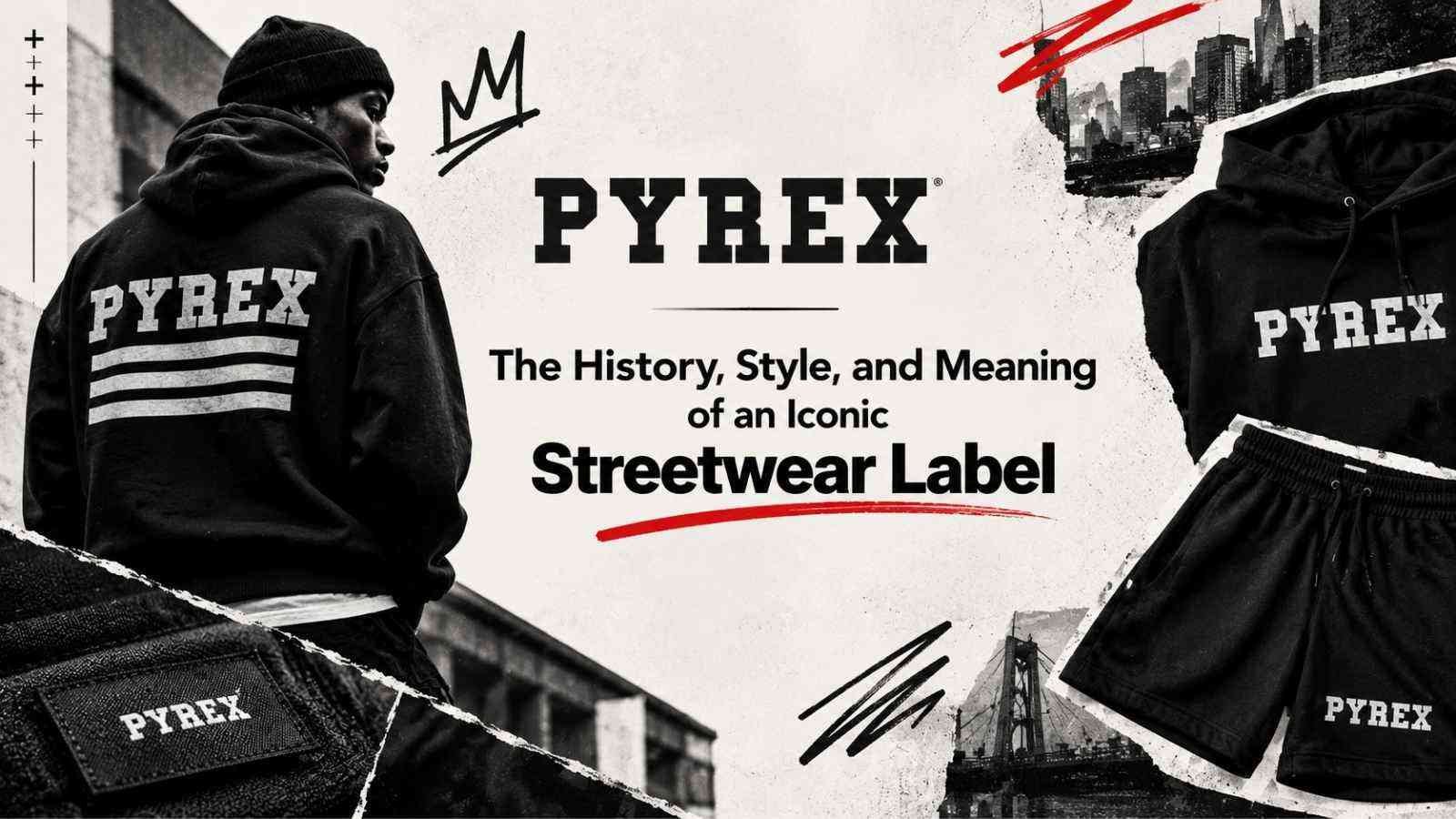
Pyrex Vision is an early streetwear label created by designer Virgil Abloh in 2012. It became known for bold graphics, sportswear-inspired clothing, and a distinctive approach to branding. Although the project was short-lived, its influence remains visible in conversations about modern streetwear, designer fashion, and collectible clothing.
For people researching Pyrex Vision today, the main questions are straightforward. What was the label? Why did it attract attention? What makes a Pyrex Hoodie or Pyrex Shorts recognizable? And what should buyers know before purchasing a vintage piece?
Understanding the label requires more than looking at its printed graphics. Its importance also comes from the way Abloh approached existing garments, visual identity, and the relationship between streetwear and luxury fashion.
This guide explains the documented background of Pyrex Vision, its design characteristics, the clothing associated with it, and practical considerations for collectors in the United States. It also covers secondhand shopping, garment care, styling, and authenticity checks without treating every item advertised under the name as genuine.
1. What Is Pyrex Vision?
Pyrex Vision was a fashion project associated with Virgil Abloh, the American designer who later founded Off-White and became the artistic director of Louis Vuitton’s menswear division. The project launched in 2012 and occupied an important place in the early development of his fashion career. Vogue’s career timeline identifies Pyrex Vision as Abloh’s first label before Off-White emerged in 2013.
Unlike a conventional clothing line built around an entirely new design language, Pyrex Vision drew attention to the transformation and recontextualization of familiar apparel. Its visual approach connected sportswear, graphic printing, and luxury-fashion presentation.
What made the label different?
Several elements help explain why Pyrex Vision continues to attract interest:
- Bold branding: Large lettering and prominent graphics made the clothing visually recognizable.
- Sportswear influences: The label was associated with casual garments, including tops, hoodies, and athletic-inspired pieces.
- Existing garment references: Contemporary reporting describes Abloh’s use of repurposed Ralph Lauren rugby flannels as part of the project’s approach.
- Art and fashion crossover: Abloh described Pyrex Vision as an art project, rather than simply a conventional fashion business.
- A connection to later work: The project preceded Off-White and provides context for understanding Abloh’s early experiments with branding and fashion.
These characteristics should be understood as broad design references, not a checklist that proves whether an individual garment is authentic. Other brands and independent sellers can reproduce similar graphics and silhouettes.
Was Pyrex Vision a long-running clothing brand?
No. Pyrex Vision was a short-lived project. Its brief existence is one reason it is now discussed as archive streetwear rather than as a continuously operating fashion label with regular seasonal collections.
The available historical sources place its launch in 2012 and the founding of Off-White in 2013. Those dates provide a useful starting point for understanding the relationship between the two projects. They do not, by themselves, establish the exact production date of every garment sold under the Pyrex Vision name.
2. Who Created Pyrex Vision and How Did It Influence Streetwear?
Virgil Abloh created Pyrex Vision during the early stages of a career that later connected streetwear, music, contemporary art, and luxury fashion. His work became influential partly because he questioned established boundaries between these fields.
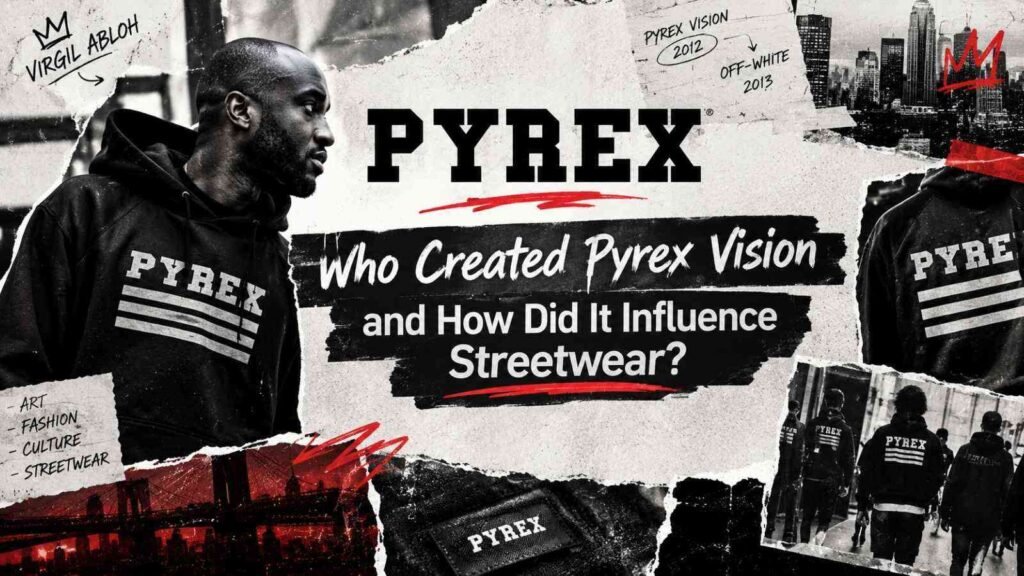
Abloh studied civil engineering and architecture before building a career in fashion. His professional experience also included work connected to music and creative collaboration. These varied interests helped inform his approach to clothing as a medium for ideas, graphics, and cultural references.
Pyrex Vision was an early expression of that approach.
The relationship between Pyrex Vision and Off-White
Pyrex Vision and Off-White are connected through Abloh, but they are not interchangeable names.
Pyrex Vision appeared first, in 2012. Off-White followed in 2013 and developed a broader identity through its clothing, visual language, collaborations, and fashion presentations.
The earlier project is useful for understanding how Abloh explored the placement of graphics on familiar garments and used branding to change how those garments were perceived. Off-White later became the more established fashion business, while Pyrex Vision remained a relatively brief chapter in his career. <Cite refs={[“turn884621search1″,”turn884621search6”]}/>
Why does Pyrex Vision still matter?
Its continuing interest reflects several developments in fashion.
First, streetwear became increasingly visible within luxury fashion. Clothing once associated mainly with casual dress, music, skate culture, and sportswear gained a larger place in designer collections.
Second, branding became an important part of how consumers interpreted garments. A familiar silhouette could communicate something different through typography, placement, and cultural association.
Third, archive fashion created a way to study earlier moments in a designer’s career. Collectors may seek a garment because it represents a particular design period, even if the item is no longer part of a current collection.
Pyrex Vision sits at the intersection of these developments. Its significance is not simply that the clothing had large graphics. It also represents an early stage in the work of a designer whose later career helped connect streetwear with major luxury institutions.
However, its historical influence should not be confused with proof that every garment carrying the name has collectible value. Condition, provenance, authenticity, and actual buyer demand all matter when evaluating an individual piece.
3. The Signature Design Features of Pyrex Vision Clothing
Pyrex Vision is often recognized through its graphics and sportswear references. However, individual pieces can differ in color, cut, fabric, print placement, and construction. Buyers should examine each garment rather than assume that every item follows one standard design.
Bold lettering and graphic placement
Prominent lettering is one of the most recognizable visual elements associated with Pyrex Vision. Large printed designs can turn a basic T-shirt, hoodie, or pair of shorts into the main focus of an outfit.
Graphic placement matters as well. A print across the chest creates a different visual effect from lettering on the back or a smaller mark near the hem.
When examining a garment, look at the complete design. Record the lettering, placement, proportions, colors, and any additional numbers or graphics. These details can help you compare an item with documented examples, but they cannot establish authenticity on their own.
Sportswear-inspired silhouettes
The label’s visual identity is associated with familiar casual clothing, including T-shirts, hoodies, and athletic-inspired garments. Such pieces are easy to incorporate into everyday wardrobes because their basic forms are already familiar.
Some archive examples have relaxed or oversized proportions. However, not every Pyrex Vision garment should be assumed to have the same fit. Original measurements and the garment’s individual construction are more useful than a general description such as oversized.
Strong visual contrast
Black, white, red, and other contrasting combinations can make printed graphics more noticeable. The precise color palette varies by garment, so these colors should be treated as styling examples rather than a complete catalog of the label’s releases.
For buyers, the practical lesson is to inspect the print against the base fabric. Look for fading, cracking, peeling, or uneven wear. On a vintage item, some deterioration may reflect age and use, but the seller should disclose its condition accurately.
Why familiar designs are not enough to prove authenticity
Graphic streetwear is relatively easy to imitate. A seller can reproduce large lettering, athletic silhouettes, and familiar color combinations without offering an original archive piece.
A useful assessment considers several factors together:
- The garment’s labels and care information.
- The fabric, seams, stitching, and construction.
- The exact graphic design and its placement.
- The item’s measurements and stated condition.
- The seller’s photographs, history, and documentation.
- Comparison with reliable examples of the specific piece.
No single visual feature guarantees that a garment is genuine. A careful comparison of the entire item is more useful than relying on its most recognizable graphic.
4. Pyrex Hoodie: Features, Fit, and Everyday Wear
A Pyrex Hoodie is a useful example of how the label’s graphic approach can be applied to an everyday garment. Hoodies are familiar streetwear staples, but a prominent print can give one a different visual role from an unbranded sweatshirt.

Archive listings include Pyrex Vision hoodies, although individual examples differ in their size, condition, and asking or sale price. The existence of resale listings does not establish that every listing is authentic or that a particular price represents the wider market. <Cite refs={[“turn884621search10″,”turn884621search13”]}/>
What should you look for in a Pyrex Hoodie?
Start with the physical garment rather than the name in the listing.
Fabric and weight: Examine the material composition when a care label is available. A hoodie can feel light, medium-weight, or heavy depending on its fabric and construction. Do not assume a particular cotton percentage without checking the garment’s label or reliable product documentation.
Graphic condition: Look for cracks, peeling, discoloration, and areas where the print has worn away. Ask for close-up photographs if the listing images do not show these details.
Cuffs and hem: Ribbed cuffs and lower hems can stretch or lose their shape over time. Check whether the garment still sits as expected.
Hood and drawstrings: Inspect the hood seams, drawstring openings, and any signs of repair or damage.
Interior labels: Review the brand label, size information, and care instructions. Compare them with credible references for the exact garment rather than using a generic online checklist.
How should a Pyrex Hoodie fit?
Fit depends on the specific garment and the look you want. Three common approaches work well for graphic streetwear.
- Regular fit: Choose a hoodie that sits comfortably at the shoulders and allows normal movement. It works with straight-leg jeans and simple sneakers.
- Relaxed fit: A little extra room creates an informal silhouette without making the garment dominate the outfit.
- Oversized fit: A wider body and longer sleeves can create a more pronounced streetwear look. Check the actual measurements instead of automatically buying a larger size.
A useful buying method is to measure a hoodie you already own and like. Measure its chest width, shoulder width, body length, and sleeve length. Compare those figures with the seller’s measurements.
This approach is more reliable than assuming that a vintage size large will fit like a modern size large.
How can you style a Pyrex Hoodie?
A graphic hoodie usually works best when the rest of the outfit supports its visual weight.
For a simple US streetwear outfit, pair it with straight-leg denim and low-profile sneakers. For a relaxed look, try loose trousers and understated footwear. In colder weather, a plain jacket can provide another layer without competing with the graphic.
You do not need matching branded pieces to complete the outfit. Neutral clothing can make the hoodie the focal point while keeping the overall look practical.
5. Pyrex Shorts: Design, Fit, and Styling
Pyrex Shorts appeal to people who prefer athletic-inspired clothing and relaxed summer outfits. As with other archive pieces, the name alone does not establish a consistent fabric, inseam, fit, or graphic arrangement across every example.
Before purchasing, identify the exact garment and inspect its measurements. Two pairs of shorts can have different proportions even when their labels display the same size.
What to check before buying Pyrex Shorts
Waistband: Check whether the waistband is elastic, adjustable, or structured. If a drawstring is present, inspect its condition and how securely it is attached.
Inseam and overall length: Inseam measurement affects how the shorts sit on the leg. Compare it with a pair you already wear comfortably.
Leg opening: A wider leg opening creates a different silhouette from a closer fit. Photographs taken straight on can help, but measurements are more reliable.
Fabric: Check the material composition and look for thinning, snags, stains, or previous repairs. Athletic-inspired appearance does not automatically mean that the garment uses technical sports fabric.
Print and branding: Inspect the graphics closely. Look for damage and compare the design with reliable references for the specific piece.
How to style Pyrex Shorts
For warm weather, pair graphic shorts with a plain T-shirt and simple sneakers. A restrained top helps prevent several competing graphics from overwhelming the outfit.
A hoodie can also work with shorts when the weather allows it. Choose proportions that feel balanced: a relaxed hoodie can pair with shorts that have a clear shape and an appropriate length.
For a more athletic look, try a plain sweatshirt or T-shirt with crew socks and comfortable sneakers. For everyday errands, a basic tee and lightweight outer layer may be enough.
The aim is to make the shorts part of a coherent outfit rather than building the entire look around matching labels.
Pyrex Shorts versus ordinary athletic shorts
The main distinction is usually visual and contextual, rather than a guaranteed difference in performance.
| Feature | Pyrex Shorts | Ordinary athletic shorts |
| Main appeal | Archive fashion and graphic identity | Everyday sportswear and comfort |
| Design | May feature prominent branding or graphics | Often uses simpler branding or team designs |
| Fabric | Must be checked on the individual garment | Varies by intended activity and product |
| Fit | Depends on the specific piece | Depends on the model and sport |
| Buying considerations | Authenticity, provenance, condition, measurements | Fit, material, function, and price |
| Best use | Casual streetwear and collecting | Exercise, leisure, and everyday wear |
Neither category guarantees better construction or comfort. Choose according to the garment’s actual features and intended use.
6. Pyrex Vision Compared With Other Streetwear
Pyrex Vision is best understood within the wider streetwear landscape. Its use of familiar garments and prominent graphics provides a useful comparison with sportswear, graphic casualwear, and designer streetwear.
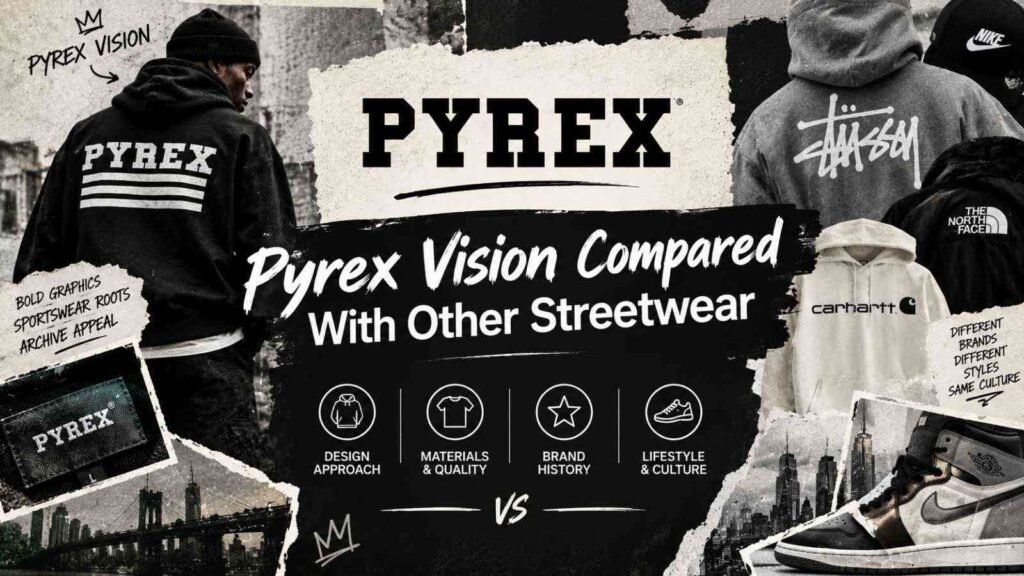
The important difference is not that one category is automatically superior. Each serves a different purpose, and the right choice depends on whether you value historical context, practical use, current design, or collecting.
Pyrex Vision and conventional sportswear
Conventional sportswear is usually evaluated by how well it performs its intended function. For running or training, buyers may prioritize breathability, stretch, moisture management, and freedom of movement.
Pyrex Vision is more often discussed in the context of visual design and fashion history. That does not mean an archive garment cannot be comfortable. It means buyers should not assume that its appearance indicates modern athletic performance.
Pyrex Vision and contemporary graphic streetwear
Contemporary graphic streetwear includes everything from inexpensive printed T-shirts to designer clothing. Many products use oversized lettering, bold colors, and athletic references.
Pyrex Vision differs in its historical connection to Abloh and its place in the development of his later design work. A new garment with similar graphics may create a comparable visual effect, but it does not carry the same documented history.
Pyrex Vision and Off-White
The relationship between the labels is important, but the two should not be confused. Pyrex Vision was an early, short-lived project. Off-White became the more established label associated with Abloh’s later career.
Someone interested in the development of his design approach may find both labels relevant. A person simply looking for graphic streetwear, however, may care more about fit, comfort, price, and condition than the distinction between archive labels.
The best comparison starts with your purpose. Are you buying clothing to wear regularly, collecting a particular period of fashion, or researching Abloh’s career? Your answer will help determine what information matters most.
7. How to Buy Pyrex Vision in the United States
Most buyers researching older Pyrex Vision clothing will encounter the secondhand market. Archive-fashion marketplaces and individual resellers can offer access to pieces that are no longer part of a regular retail collection.
However, a listing is only a starting point. Buyers need to evaluate the individual garment, the seller, and the terms of the transaction before paying.
Where should you look?
Potential sources include established resale marketplaces, specialist archive-fashion sellers, consignment stores, and private sellers. Grailed, for example, has a Pyrex Vision designer category and listings for archive garments. Its listings can help buyers understand how sellers describe different items, but the presence of a listing does not independently prove authenticity.
When comparing listings, look for:
- Clear photographs of the front and back.
- Close-ups of the labels, graphics, and construction.
- Measurements rather than size labels alone.
- A detailed description of stains, repairs, fading, or print damage.
- A seller with a traceable transaction history.
- Clear shipping, return, and buyer-protection terms.
Avoid paying through a method that removes the protections available through the marketplace when those protections are important to your purchase.
How much does Pyrex Vision cost?
There is no single reliable price for every Pyrex Vision garment. Prices can differ according to the item, condition, size, provenance, seller, and demand.
A sold listing provides a record of one transaction, not a universal valuation. For example, a particular hoodie may sell for a different amount from another hoodie with a different condition or design. Asking prices can also differ significantly from final sale prices.
To estimate a reasonable price:
- Find several examples of the same or closely comparable garment.
- Prioritize completed sales when the platform makes them available.
- Compare condition, measurements, and included documentation.
- Account for shipping, taxes, and any applicable import costs.
- Treat unusually low prices and unsupported claims of rarity with caution.
Do not assume that an older item is automatically valuable. Collectible status does not guarantee strong resale demand.
Is buying secondhand worth it?
It can be, particularly if you want a specific archive piece or are interested in Abloh’s early work. Secondhand buying also makes condition assessment more important because the garment may have experienced years of wear.
If your main goal is to wear a graphic hoodie or pair of shorts, compare the archive piece with contemporary alternatives. You may decide that the historical connection is worth the extra research, or you may prefer a simpler garment that is easier to replace.
The decision should reflect your budget, intended use, and confidence in the item’s authenticity.
8. How to Check Pyrex Vision Authenticity
Authenticity is one of the most important considerations when shopping for archive streetwear. A convincing graphic or familiar label is not enough to establish that a garment is genuine.
There is no single universal check that can conclusively authenticate every Pyrex Vision item. A more reliable approach combines garment inspection, comparison with credible references, seller research, and available provenance.
Examine the labels and construction
Start with the neck label, care label, and any other identifying details. Check the spelling, printing, placement, stitching, and information provided.
Next, examine the garment itself. Look at the seams, fabric, cuffs, hems, and print quality. Note anything that appears inconsistent, but do not automatically classify an unusual detail as proof of a fake. Vintage clothing can vary, and wear or repairs can alter its appearance.
Compare the exact design
Find documented examples of the same garment, not merely another item carrying the Pyrex Vision name.
Compare the graphic’s size and position, lettering, color, silhouette, and identifying details. If reliable reference photographs are unavailable, acknowledge that uncertainty rather than treating a loose visual resemblance as confirmation.
Assess the seller and provenance
Ask where the garment came from and whether the seller has supporting purchase records, earlier ownership information, or other relevant documentation.
A receipt or ownership story may help establish provenance, but it should not be treated as conclusive proof by itself. Consider whether the account is consistent with the garment and the available evidence.
For an expensive purchase, consider a reputable authentication service that has experience with the specific type of archive clothing. Review its process and limitations before paying for an assessment.
Warning signs worth investigating
Be cautious when a seller:
- Refuses to provide close-up photographs.
- Uses only generic images instead of photographs of the actual item.
- Gives inconsistent information about the garment’s history.
- Claims that one logo or label guarantees authenticity.
- Pressures you to pay immediately.
- Offers no clear explanation of the item’s condition.
These are reasons to investigate further, not automatic proof of counterfeiting.
The safest conclusion is evidence-based: if the details cannot be verified, describe the garment as unverified rather than claiming certainty.
9. How to Care for Pyrex Vision Hoodies, Shorts, and Other Garments
Vintage and archive clothing benefits from careful handling. The correct method depends on the garment’s fiber content, construction, print, and existing condition.
Start by reading the care label. If the label is missing or unclear, avoid assuming that a garment can tolerate the same treatment as a modern cotton T-shirt.
Washing graphic clothing
For garments that are suitable for home washing:
- Turn the garment inside out to reduce direct friction on the print.
- Use a gentle washing cycle when appropriate for the fabric.
- Choose a detergent suitable for the material.
- Avoid excessive heat if the care instructions warn against it.
- Do not scrub printed areas aggressively.
- Inspect the garment after washing before deciding whether another treatment is needed.
These are general precautions, not a substitute for the garment’s own care instructions. Some materials or finishes may require a different method.
Drying and storage
High heat can affect some fabrics, elastic components, and printed finishes. Follow the care label’s drying instructions and use a lower-impact method when suitable.
Before storing a hoodie or pair of shorts, make sure it is clean and fully dry. Store the garment away from direct sunlight and excessive moisture. Avoid placing heavy items on delicate prints for long periods.
If the garment has significant cracking, peeling, or fragile fabric, avoid experimenting with aggressive cleaning products. A professional cleaner experienced with vintage clothing may be a safer choice.
Should you repair damaged graphics?
That depends on the garment’s condition and your goal.
For everyday wear, a repair may be reasonable if it prevents further damage. For collecting, an alteration can affect the item’s originality and how future buyers assess it.
Document existing damage before attempting repairs. If you intend to preserve the garment as an archive piece, consider seeking advice before making irreversible changes.
10. How to Build a Wardrobe Around Pyrex Vision
Pyrex Vision clothing can be worn as part of a practical wardrobe without turning every outfit into a historical recreation. The most useful approach is to combine one visually distinctive piece with clothing that suits your normal routine.
Start with one statement garment
A Pyrex Hoodie or graphic T-shirt can serve as the focal point of an outfit. Keep the other pieces simple if you want the print to stand out.
For example:
- Everyday outfit: Graphic hoodie, straight-leg jeans, and sneakers.
- Warm-weather outfit: Pyrex Shorts, a plain T-shirt, and casual footwear.
- Layered outfit: Graphic top, understated jacket, and relaxed trousers.
- Minimal outfit: One archive piece with neutral clothing and limited accessories.
These are styling suggestions, not prescribed looks from the original label.
Balance fit and proportion
Consider how the top and bottom work together. A roomy hoodie can pair with straight-leg or relaxed trousers. If both pieces are very wide, pay attention to length and shape so the outfit still looks intentional.
With shorts, compare the hem length and leg opening with the proportions of your top. A plain T-shirt can balance a graphic bottom, while a hoodie adds visual weight in cooler weather.
Decide what matters before spending
Before buying, ask yourself three questions:
- Do I want this item because of its history, its design, or its everyday function?
- Is the condition acceptable for how I plan to wear it?
- Can I verify enough information to justify the price?
These questions help separate genuine personal interest from pressure created by scarcity claims or resale trends.
Key Takeaways
- Pyrex Vision was a short-lived fashion project associated with Virgil Abloh that launched in 2012.
- The label is relevant to the history of graphic streetwear and Abloh’s later work with Off-White.
- A Pyrex Hoodie or Pyrex Shorts should be assessed as an individual garment. Fit, material, graphics, and condition can vary.
- Archive clothing prices depend on the item and market evidence. One listing does not establish a standard value.
- Authenticity requires more than a recognizable logo. Compare the complete garment and review the seller’s evidence.
- Follow the garment’s care instructions, especially when its fabric or printed graphics are fragile.
- Buy according to your intended use, budget, and interest in the garment’s history rather than unsupported rarity claims.
Conclusion
Pyrex Vision occupies a distinctive place in the early career of Virgil Abloh and the development of modern streetwear. Its short history, graphic approach, and relationship to his later work explain why collectors and fashion enthusiasts continue to research the label.
For buyers in the United States, the most important considerations are practical. Understand the item’s background, compare the actual garment with reliable references, check its condition, and evaluate the seller before purchasing.
Whether you are interested in a Pyrex Hoodie, Pyrex Shorts, or another archive piece, the strongest buying decision comes from separating documented facts from assumptions. That approach makes it easier to appreciate the clothing’s design and history while avoiding unsupported claims about authenticity or value.
Frequently Asked Questions About Pyrex Vision
1. What is Pyrex Vision?
Pyrex Vision was a short-lived fashion project created by Virgil Abloh in 2012. It became known for graphic clothing, sportswear references, and an experimental approach to branding. The project preceded Off-White, which Abloh founded in 2013.
2. Is Pyrex Vision the same as Off-White?
No. Pyrex Vision and Off-White were separate projects associated with Virgil Abloh. Pyrex Vision came first, while Off-White developed into a more established fashion label. They are connected through Abloh's career but should not be treated as interchangeable brands.
3. What should I check before buying a Pyrex Hoodie?
Check the garment's labels, fabric, stitching, print placement, measurements, and condition. Compare it with reliable references for the exact design and research the seller's history. A recognizable logo alone does not prove authenticity.
4. Are Pyrex Shorts worth buying?
They may be worth buying if you appreciate the design, historical connection, or archive-fashion appeal. Their value depends on the specific item, authenticity, condition, provenance, and market demand. Compare completed sales when available instead of relying only on asking prices.
5. How do I care for Pyrex Vision clothing?
Follow the garment's care label and consider its fabric, printed graphics, and existing wear. Turning suitable graphic garments inside out before washing can reduce friction on the print. Avoid aggressive cleaning methods, and seek professional advice if a fragile vintage item needs special treatment.
Read More: Fashion